

Views: 0 Author: Site Editor Publish Time: 2026-08-13 Origin: Site

Relying solely on auditory or visual cues leaves critical gaps in emergency response. In commercial and industrial environments, a single mode of notification often fails against high ambient noise floors, complex floor plans, or the presence of hearing-impaired occupants. Facility managers and fire protection engineers must balance strict regulatory compliance with these environmental challenges, ensuring that alerts are universally recognized without triggering photosensitive medical events.
The industry-standard solution to this complex life-safety requirement is the dual-modal notification appliance. By integrating acoustic and optical engineering, these devices guarantee notification across diverse sensory capabilities. This guide explores the technical mechanics of evaluating, selecting, and implementing these critical life-safety devices based on acoustic and optical performance data, ensuring your facility meets stringent codes like ADA, NFPA 72, and EN54.
Dual-Modal Efficacy: A fire sounder strobe integrates piezoelectric acoustics and high-intensity optics (Xenon or LED) to guarantee notification across diverse sensory capabilities and environmental conditions.
Compliance is Metric-Driven: Selection must be dictated by specific candela (cd) ratings for room volume and decibel (dB) outputs that exceed ambient noise levels by a minimum regulatory threshold (typically 15 dB).
Synchronization is Mandatory: Modern audiovisual fire alarm networks require strict strobe synchronization to prevent the risk of triggering photosensitive epilepsy in occupants.
Power Draw Trade-offs: The shift from traditional Xenon bulbs to LED sounder strobe lights significantly reduces inrush current and voltage drop, allowing for more devices per circuit and lowering overall installation costs.
To evaluate a unit's reliability, buyers must understand the underlying engineering that generates simultaneous, high-impact alerts without causing circuit failure. A Fire Sounder Strobe is a precision-engineered life-safety instrument designed to operate flawlessly under extreme duress. We see these units deployed across massive warehouse floors and tight office corridors, and their internal components dictate how well they perform in each setting.
The fire protection industry has largely shifted away from legacy electromechanical bells, favoring modern piezoelectric transducers. These solid-state components undergo rigorous UL 464 auditing standards to ensure consistent sound pressure levels over extended durations. Piezoelectric elements function by converting electrical energy directly into acoustic waves. When an alternating voltage is applied, the ceramic element rapidly flexes, displacing air to create sound.
This electronic generation allows for multiple selectable tone patterns programmed directly into the device. Common configurations include the Temporal 3 pattern universally recognized for evacuation, the Temporal 4 pattern designated for carbon monoxide alerts, as well as continuous or sweep tones for specific industrial signaling. Directional sound dispersion and frequency selection are equally critical. While standard high-frequency 3 kHz tones cut through typical office noise, low-frequency 520 Hz square wave tones are now required in sleeping areas, as studies prove they are significantly more effective at waking sleeping occupants, particularly those with mild hearing loss.
When installing these units, technicians must measure the ambient noise floor. If a manufacturing plant operates at 85 dBA, the acoustic output of the notification appliance must hit at least 100 dBA in that specific zone. This often requires strategic placement of multiple units rather than relying on a single high-output device, which could cause hearing damage to personnel working immediately adjacent to it.
The visual component relies on advanced optical engineering to ensure the flash is visible even in bright environments. The mechanics of a sounder strobe light are strictly governed by standards such as UL 1971 for public mode signaling and UL 1638 for private or outdoor mode signaling. These standards dictate exact light dispersion patterns, ensuring the flash covers a specific three-dimensional volume rather than just projecting a narrow beam straight ahead.
Historically, legacy Xenon flashtubes dominated the market. Xenon tubes operate via a high-energy electrical discharge through a noble gas, producing an omnidirectional, high-intensity burst of light. However, they draw substantial inrush current and generate significant heat. Modern LED arrays have revolutionized this space. LEDs are highly efficient, highly directional, and generate minimal heat. By utilizing precision-engineered reflectors and lens optics, manufacturers shape the LED light pulse to meet regulatory horizontal and vertical polar dispersion patterns.
Lens coloring also dictates application. Clear lenses are the universal standard for fire evacuation. Conversely, amber, blue, or red lenses are frequently deployed in mass notification systems to indicate active shooter lockdowns, severe weather warnings, or chemical spills. You must ensure the lens color aligns with the specific emergency protocol of the facility.
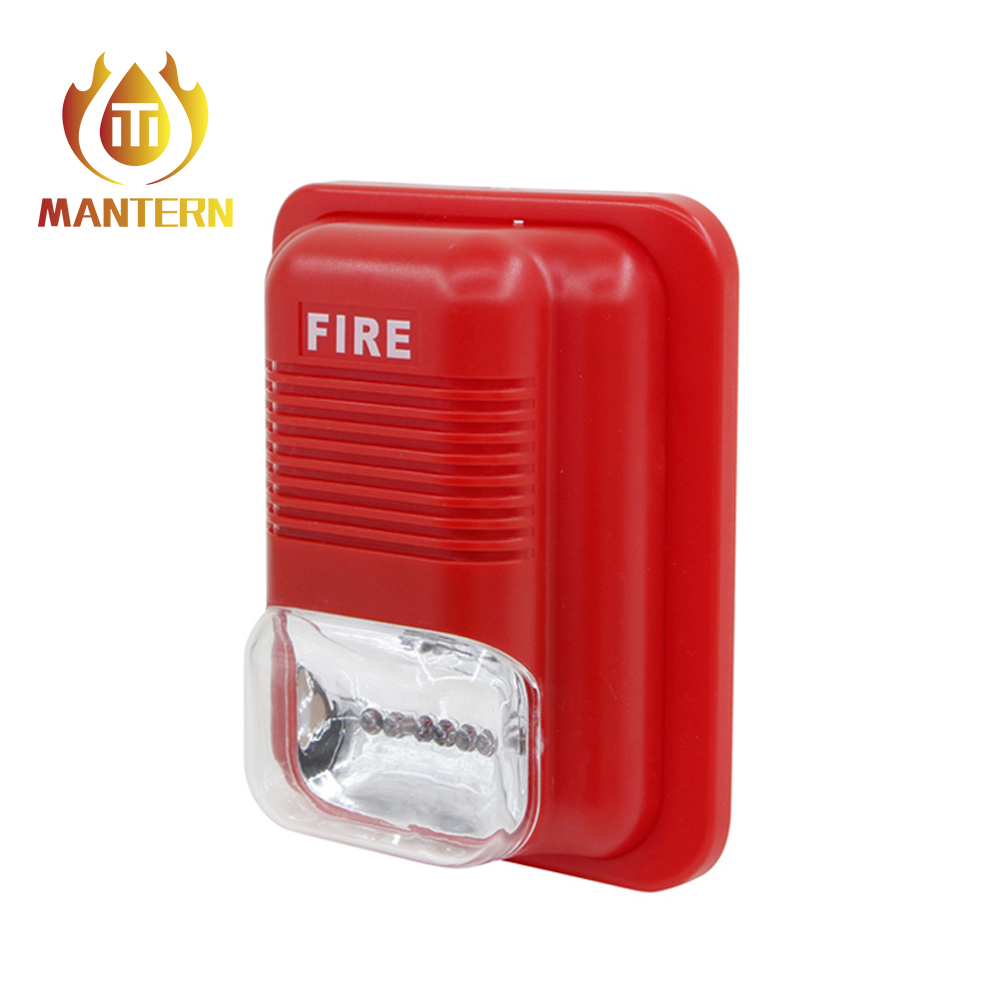
Selecting the correct architecture requires matching the facility's scale and existing infrastructure with the appropriate notification technology. The market offers distinct categories of devices tailored for different operational demands. We evaluate these based on wiring infrastructure, environmental hazards, and physical mounting constraints.
A conventional alarm siren strobe operates via simple voltage-reversal activation. When the fire alarm control panel detects an alarm state, it reverses the polarity on the notification appliance circuit (NAC), powering all devices on that loop simultaneously. This architecture is highly cost-effective and straightforward to install, making it ideal for small footprints like retail stores or standalone offices. However, it lacks individual device diagnostics; a fault on the circuit requires manual troubleshooting to locate the specific point of failure.
Addressable units utilize data-driven activation. Each device possesses a unique address on the network, allowing the control panel to poll them individually. This enables electronic diagnostic testing, including automated self-test capabilities that verify acoustic and optical function without requiring a technician to physically inspect every unit during a blaring alarm. Addressable systems are ideal for large, complex campuses requiring precise control, phased evacuation sequences, and long-term maintenance efficiency.
System Type | Activation Method | Diagnostic Capability | Best Application |
|---|---|---|---|
Conventional | Voltage Reversal (NAC) | Zone-level only | Small retail, single-story offices |
Addressable | Digital Data Polling | Individual device self-testing | Hospitals, university campuses, high-rises |
Environmental resilience is a primary evaluation criterion. Devices installed outdoors or in harsh industrial settings must carry specific Ingress Protection (IP) and NEMA ratings. A NEMA 4X or IP66 rating indicates the unit is dust-tight and protected against powerful water jets, making it mandatory for wash-down environments in food processing or exterior building mounts exposed to heavy rain.
Temperature operating ranges also heavily influence selection. Extreme cold can severely impact strobe flash rates and reduce acoustic output, particularly in older Xenon models. Devices specified for freezers or cold-weather outdoor climates must be explicitly listed for extended temperature ranges. Furthermore, facilities involved in oil, gas, or chemical processing require Class I, Division 2 hazardous area classifications. These explosion-proof units are sealed to prevent internal electrical arcs from igniting volatile atmospheric vapors.
The physical installation architecture impacts both aesthetics and labor time. Evaluators must consider shallow versus deep backbox profiles. Deep backboxes provide ample wire-bending space, accelerating installation speed and reducing the risk of pinched wires causing ground faults. Surface, flush, and semi-flush mounting options are available for both walls and ceilings, dictated by architectural constraints and NFPA 72 placement rules.
In environments prone to vandalism or accidental impact—such as gymnasiums, warehouses, or correctional facilities—high-impact physical protection is necessary. Heavy-duty wire guards or polycarbonate covers can be installed over the units. However, any guard must be UL-listed for use with that specific appliance to ensure it does not unacceptably degrade the required light output or muffle the acoustic signal.
Technical specifications must map directly to life safety success criteria and regulatory mandates. Understanding how to interpret performance metrics ensures the deployed system functions exactly as required during an emergency. We rely on hard data to dictate device placement.
The standard formula for audible success is strict: the sounder must produce a signal at least 15 dBA above the average ambient sound level, or 5 dBA above the maximum ambient sound level lasting more than 60 seconds (using the A-weighted decibel scale). If a manufacturing floor operates at 85 dBA, the notification appliance must deliver at least 100 dBA to that specific area.
Facility designers must account for the inverse square law. Sound pressure drops significantly over distance—typically 6 dB for every doubling of distance in a free field. A device rated for 100 dB at 10 feet will only deliver 94 dB at 20 feet, and 88 dB at 40 feet. This mathematical reality dictates device spacing in long corridors, open warehouses, and compartmentalized office spaces, often requiring more devices operating at lower individual volumes to achieve uniform coverage without deafening occupants nearest the sounders.
Candela measures luminous intensity and the visual contrast the flash creates against ambient lighting. Selection is entirely dependent on room size and layout. Standard evaluation lenses dictate specific candela ratings for different volumes: 15 cd is typically sufficient for small offices (20x20 feet), while 110 cd or 135 cd is required for large open areas. Sleeping rooms demand a minimum of 110 cd if wall-mounted close to the ceiling, or 177 cd if ceiling-mounted, to ensure the flash penetrates closed eyelids.
Designers face a trade-off between using fewer high-candela units versus multiple low-candela units. While a single 135 cd unit might mathematically cover a large room, physical obstacles like tall shelving or partitions create shadowing. In complex layouts, deploying multiple 15 cd or 30 cd units provides better line-of-sight coverage, though it requires careful calculation of total power consumption on the circuit.
A critical safety requirement for any audiovisual fire alarm is the synchronization of flash rates. Regulatory codes mandate a flash rate of typically 1 flash per second (1 Hz) to 2 flashes per second (2 Hz). If multiple strobes in a single field of view flash randomly out of sync, the combined effect can exceed 5 Hz, creating a severe risk of triggering photosensitive epileptic seizures in vulnerable occupants.
Synchronization modules or compatible fire alarm control panels (FACPs) manage this by sending a precise timing pulse down the circuit. This aligns the timing of both the visual flashes and the audible temporal patterns across an entire notification zone, ensuring a uniform, compliant, and medically safe evacuation signal.
Addressing the physical and regulatory realities of installing or retrofitting these systems prevents costly code violations and ensures long-term operational resilience. We see many installations fail inspection due to improper wiring topologies or voltage drop miscalculations.
Compliance requires strict adherence to regional codes. The Americans with Disabilities Act (ADA) mandates specific heights for visual alerts (typically 80 to 96 inches above the finished floor) and strict flash rate limitations. NFPA 72 governs spacing, placement rules, and the exact candela requirements based on room dimensions. In European markets, EN54 standards dictate similar but distinct testing and performance criteria.
The primary risk mitigation strategy during procurement is mandating third-party testing certifications. Devices must bear marks from recognized testing laboratories such as UL, FM Global, or ULC. Installing unlisted devices invalidates system compliance and exposes the facility to immense liability.
Wiring pathway survivability directly impacts system resilience. Class B (Style Y) pathways utilize radial wiring that terminates with an end-of-line resistor. It is cheaper and faster to install, but if a single open circuit (wire break) occurs, all devices downstream of the break lose power and fail to operate.
Class A (Style Z) pathways utilize redundant loop wiring that returns to the control panel. If a single open circuit occurs, the panel feeds power from both directions, ensuring all devices continue to operate. Critical infrastructure, hospitals, and high-rise buildings typically mandate Class A wiring to guarantee notification even if building damage severs a conduit.
Feature | Class B Wiring (Style Y) | Class A Wiring (Style Z) |
|---|---|---|
Topology | Radial / Branching | Redundant Loop (Returns to Panel) |
End-of-Line Resistor | Required at the last device | Internal to the panel |
Single Wire Break Result | Loss of all downstream devices | All devices remain operational |
Installation Cost | Lower (less wire, simpler routing) | Higher (more wire, return path required) |
The most common installation failure is exceeding the power supply capacity of the Notification Appliance Circuit (NAC). As current travels down long wire runs, the natural resistance of the copper causes the voltage to drop. If the voltage drops below the appliance's minimum operating threshold (typically 16V on a 24V system), the devices at the end of the line will fail to activate.
Engineers must calculate voltage drop using wire gauge (AWG) resistance values and the total current draw of all devices on the loop. The most effective mitigation strategy is specifying LED-based units, which drastically reduce inrush current and overall power consumption compared to Xenon. For legacy retrofits where wire cannot be easily replaced, deploying auxiliary booster power supplies (NAC extenders) near the devices restores voltage levels and ensures reliable activation.
A fire sounder strobe is a highly engineered life-safety device where acoustic and optical performance must perfectly align with environmental variables. Selecting the right equipment requires a methodical approach to acoustics, optics, and electrical engineering constraints.
Audit your facility's ambient noise levels and room dimensions to establish baseline performance requirements.
Select appropriate decibel and candela ratings that exceed regulatory minimums for your specific floor plan.
Calculate NAC power limitations and voltage drops to decide between LED efficiency or auxiliary power requirements.
Engage a certified Fire Protection Engineer (FPE) to conduct a comprehensive site survey and draft a compliant bill of materials.
A: A fire sounder provides the audible siren or tone, alerting occupants through sound. A fire strobe provides the visual flashing light, alerting those with hearing impairments or those in high-noise areas. A combined unit integrates both into a single housing for dual-modal notification.
A: Candela requirements depend entirely on room size and application. Per NFPA 72 guidelines, requirements range from 15 cd for small single-occupancy rooms to 110 cd for large open areas, and up to 177 cd for sleeping areas to ensure the flash wakes occupants.
A: Synchronization is a strict medical safety requirement. If multiple strobes in a single field of view flash out of sync, the combined rapid flash rate can trigger photosensitive epileptic seizures in vulnerable occupants. Synchronization modules keep all flashes aligned.
A: No. Addressable devices require a compatible addressable Fire Alarm Control Panel (FACP) that communicates via digital polling. They cannot be simply swapped onto a standard conventional 2-wire NAC circuit without upgrading the entire system architecture.
A: Class B wiring relies on an end-of-line resistor; a single wire break will cause all downstream devices to fail. Class A wiring loops back to the control panel, providing a redundant path that preserves the operation of all devices during a single wire break.
A: UL 1971 governs emergency notification for the hearing impaired in indoor environments, requiring strict, wide-angle light distribution patterns. UL 1638 covers private mode signaling and general utility or outdoor applications where precise light dispersion is less critical.
A: While individual devices typically output between 75 to 110 dBA at 10 feet, the regulatory requirement dictates that the tone must be at least 15 dBA above the average ambient noise level or 5 dBA above the maximum ambient noise level in the space.
Mantern Industrial Co., Ltd. is engaged in international business since 2012. Our aim is to provide good products with competitive price for our clients.
