

Views: 0 Author: Site Editor Publish Time: 2026-09-15 Origin: Site

Ever walked out to the patio in the morning only to hear the faint hiss of a burner left running overnight? Picture waking up to a completely drained propane tank, or worse, a highly combustible gas cloud lingering near your foundation. This common oversight not only burns through expensive fuel but creates a severe, immediate fire hazard.
Whether you are outfitting a high-volume commercial kitchen or upgrading a backyard barbecue island, relying purely on human memory to shut off the gas is a flawed strategy. A reliable, physical shut-off mechanism eliminates this risk entirely. In this guide, I will walk you through the engineering realities of selecting, sizing, and installing the correct fail-safe valve for your specific gas infrastructure.
Physical Fail-Safes Over Habit: A mechanical shut-off mechanism stops gas flow entirely, preventing catastrophic leaks when cooking equipment is left unattended.
Fuel-Specific Engineering: You must verify that your chosen valve's internal seals are rated for your specific fuel source—Natural Gas (NG) operates at lower pressures than Liquid Propane (LP).
BTU Capacity is Non-Negotiable: Installing an undersized valve creates a bottleneck. It will restrict fuel delivery and drastically reduce your grill's searing capability.
Mechanical Beats Electronic: Spring-wound mechanical timers remain the gold standard for outdoor and high-heat applications because they require zero electricity and shrug off harsh weather.
Code Compliance: Commercial kitchens and multi-family properties face strict local fire codes; installing an automated shut-off is increasingly becoming a mandatory insurance requirement.
From an engineering perspective, a gas timer valve is a precision fluid-control device spliced directly into the supply line of a heating appliance. Its job is simple but critical: regulate the flow of combustible gases based on a hard-coded mechanical countdown. When a user twists the dial, an internal mechanism holds the valve's gateway open. The moment that timer hits zero, the tension releases, snapping the valve shut and completely severing the fuel supply.
Integrating a high-quality automatic grill shut off into your setup provides measurable, immediate benefits across safety, operational efficiency, and regulatory compliance.
Unmatched Safety in High-Distraction Environments
The primary function of this hardware is fire prevention. Consider a chaotic Friday night in a restaurant kitchen; line cooks are constantly multitasking. The probability of a rear burner being left on after closing is surprisingly high. Similarly, distracted homeowners easily forget to secure their patio BBQ after pulling steaks off the grate. By implementing a physical timer, the risk of unignited gas accumulation or unattended grease fires drops to virtually zero.
Cost Savings and Fuel Efficiency
Leaving a standard multi-burner grill running on high will drain a standard 20-pound propane cylinder in mere hours. For commercial setups tapped into municipal natural gas lines, an unattended flat-top can burn hundreds of cubic feet of gas overnight. Think of a timer valve as a silent financial safeguard. It guarantees you only pay for the fuel actively used during cooking.
While the core physics of gas flow remain the same, the operating environments of a fast-paced restaurant and a backyard patio demand entirely different hardware specifications. Identifying your exact operational load is the first step in avoiding premature equipment failure.
Before diving into specific requirements, it is crucial to understand where the industry is heading. Recently, commercial property insurers, HOA boards, and municipal fire marshals have drastically shifted their safety protocols. We are seeing a widespread move away from behavioral training (reminding staff to turn off the gas) toward mandated physical fail-safes. In fact, many modern fire codes for multi-family rooftop patios and commercial kitchens now strictly require automated shut-off devices. Facilities are adopting these integrated mechanical timers not just to mitigate catastrophic fire risks, but to secure lower liability insurance premiums and pass stringent municipal safety audits.
Commercial kitchens are brutal environments. Equipment here must endure extreme ambient heat, airborne grease particulate, and aggressive physical handling by multiple staff members across consecutive shifts.
When specifying a commercial kitchen gas valve, high flow capacity and internal durability are your top priorities. Industrial ranges routinely draw upwards of 150,000 to 200,000 BTUs (British Thermal Units) per hour to maintain rapid recovery times. If you install a standard residential valve here, the resulting pressure drop will lead to weak, yellow flames and ruined service times.
Outdoor grills present a completely different set of engineering hurdles, primarily environmental degradation. An outdoor unit must withstand brutal ultraviolet (UV) radiation, torrential rain, coastal salt air, and freezing winter cycles without the internal gears seizing.
For these applications, look for internal manifolds machined from solid forged brass and external housings stamped from marine-grade 304 stainless steel. Furthermore, since these timers are often used by casual guests or homeowners, the user interface must be foolproof—a simple twist-dial requiring zero specialized training.
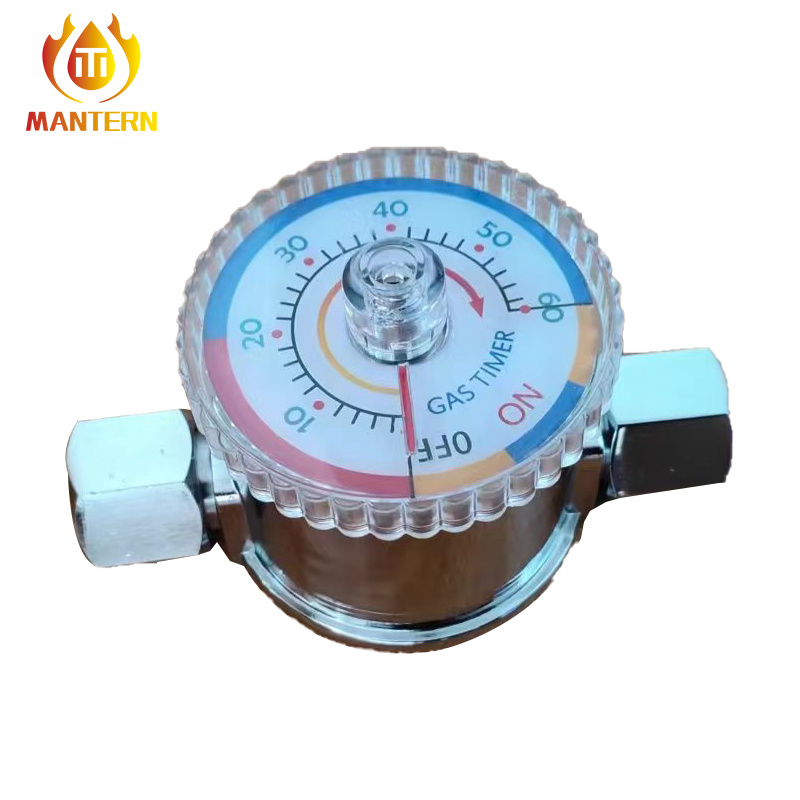
Selecting the correct hardware requires matching the valve's technical specifications to your appliance's demands. Overlooking any of the following parameters will inevitably result in poor grill performance or hazardous gas leaks.
Natural Gas (NG) and Liquid Propane (LP) possess vastly different physical properties. Propane is heavier than air and is delivered to the appliance under higher pressure—typically around 11 inches of Water Column (WC). In contrast, natural gas is lighter than air and flows at a much lower pressure, usually around 7 inches of WC.
While premium valves are often dual-rated, you must verify that the internal seals are certified to handle the specific pressure of your fuel source to prevent long-term seal degradation.
BTU flow capacity dictates the maximum volume of gas the valve permits through its chamber per hour. If you install a valve rated for 50,000 BTUs on a commercial grill demanding 120,000 BTUs, the valve chokes the system. The result? A frustrating "low flame" anomaly that prevents the grill from ever reaching a proper sear.
Standard BTU Capacity Guide by Pipe Size:
Valve Port Size (NPT) | Typical Max BTU (Natural Gas) | Typical Max BTU (Liquid Propane) | Recommended Application |
|---|---|---|---|
3/8-inch | ~60,000 BTUs | ~90,000 BTUs | Small residential grills, single side-burners |
1/2-inch | ~100,000 BTUs | ~150,000 BTUs | Standard patio BBQs, mid-size outdoor kitchens |
3/4-inch | ~250,000+ BTUs | ~300,000+ BTUs | Large commercial grills, multi-appliance manifolds |
Pro Tip: Always calculate the total combined BTU rating of all main and auxiliary burners on your grill before finalizing your valve size.
Timers are manufactured with various maximum limits, typically ranging from 60 minutes to 3 hours. For standard grilling, a 60-minute BBQ gas timer is the optimal, safest choice.
Why 60 minutes? Grilling is an active cooking process. One hour provides plenty of continuous heat to preheat heavy cast-iron grates and cook thick cuts of meat. However, it is short enough to minimize danger if the chef walks away. Longer timers (2 or 3 hours) should be strictly reserved for specialized equipment like outdoor gas fire pits or slow-smoking roasting ovens.
Plastic housings are a liability. Under constant UV exposure, plastic will warp, melt, or become brittle. Industrial-grade units feature solid brass internal cores. Brass resists corrosive impurities found in gas lines and is inherently non-sparking. Paired with a 304-grade stainless steel bezel, the dial will turn smoothly even after years of rain and snow exposure.
When evaluating safety shut-offs, you must choose between two entirely different operational technologies: mechanical springs or electronic solenoids.
A mechanical gas timer relies on a heavy-duty, spring-wound kinetic mechanism. Turning the dial manually winds the mainspring. As it slowly unwinds, a precision gear train ticks down the time. At zero, the mechanical tension releases a physical stem, slamming the gas flow shut.
The beauty of this design is its absolute fail-safe nature. It requires no electrical wiring, no batteries, and no Wi-Fi. It is immune to power outages and battery corrosion, making it the undisputed champion for outdoor and high-heat environments.
Electronic timers use a digital control board to send a continuous electrical current to a magnetic solenoid valve, holding it open. When the digital countdown ends, the current stops, and a spring forces the valve closed.
While they offer precise digital readouts, they introduce severe failure points. A sudden power outage immediately kills the gas supply unless you have a battery backup. Furthermore, delicate circuit boards degrade rapidly in the intense heat and grease-laden air of a commercial kitchen.
The Verdict: For over 90% of grilling applications, the mechanical timer is vastly superior. Its rugged independence from the electrical grid makes it the industry standard for reliable safety.
Disclaimer: Modifying gas lines carries inherent explosive risks. In commercial environments, local building codes and NFPA regulations strictly require that gas infrastructure modifications be performed by a licensed gas plumber. The following is for educational system-design purposes.
Integrating a grill shut off timer requires careful attention to sequential placement and thread sealing. Improper installation guarantees leaks.
The timer must be installed downstream from the primary pressure regulator, but upstream from the grill's main manifold.
The standard sequence flows as follows:
Gas Source: Utility meter (NG) or high-pressure tank (LP).
Primary Regulator: Drops extreme tank pressure down to safe operational levels (7-11 inches WC).
Manual Shut-Off Valve: A mandatory ball valve for total system isolation during maintenance.
Gas Timer Valve: The automated countdown mechanism.
Appliance Hose: The final conduit to the grill.
If you mistakenly install the timer before the primary regulator, the high-pressure gas will instantly blow out the timer's internal seals.
Using the Wrong Thread Sealant
Standard white Teflon tape is for water pipes. It will degrade when exposed to gas. Always use yellow, gas-rated PTFE tape or a specialized liquid pipe dope. When applying pipe dope, leave the first thread bare so the compound doesn't shear off and clog the timer's internal gears.
Triggering the "Low Flame" Propane Safety
A frequent complaint after installing a timer on a propane system is a drastically reduced flame. This is rarely a defective timer. It happens when the timer is turned on while the grill's burner knobs are already open. The sudden rush of gas triggers the propane tank's internal excess-flow safety valve. Always ensure burner knobs are completely off before twisting the timer dial.
Skipping the Pressure Leak Test
Relying on your nose to smell a leak is dangerous. Professionals use an electronic combustible gas detector or high-viscosity leak-detector fluid. If bubbles form at the joints when the system is pressurized, you have a leak. Disassemble, clean the threads, and reseal.
For property developers, restaurant owners, and OEMs, sourcing industrial-grade hardware is just as critical as the installation itself. Buying uncertified, generic valves online often leads to premature failure and massive liability exposure.
You should prioritize manufacturers that utilize premium materials—specifically solid forged brass cores and 304-grade stainless steel housings. A prime example of this engineering standard is the product line from Mantern China. They specialize in heavy-duty fluid control mechanisms designed explicitly to survive commercial kitchens and exposed coastal patios. Their mechanical timers deliver maximum BTU flow without restriction and provide consistent, fail-safe shut-offs without relying on fragile electronics. By selecting purpose-built commercial equipment, you protect your property and ensure long-term, maintenance-free operation.
Integrating a dedicated mechanical shut-off valve is one of the smartest, most cost-effective upgrades you can make to any gas appliance system. It acts as an untiring safety guardian, ensuring that a simple lapse in memory doesn't result in an empty fuel tank or a devastating property fire.
Before purchasing, audit your system. Verify your exact BTU requirements, confirm your gas type, and check your pipe sizing. By choosing robust, commercial-grade hardware, you secure peace of mind and operational efficiency for years to come. If you are ready to upgrade your infrastructure, ensure you select a valve engineered to the highest safety standards to match your specific application.
Yes, the vast majority of high-quality mechanical timers feature internal brass ball valves compatible with the chemical composition of both Natural Gas (NG) and Liquid Propane (LP). Because the timer acts as a physical gateway rather than a pressure regulator, it handles both fuels safely. However, you must ensure that your system's separate pressure regulators and burner orifices are correctly tuned for your specific gas.
It will only restrict gas flow if you purchase an undersized unit. Every valve has a maximum BTU rating based on its internal port diameter. For instance, a 3/8-inch port might handle 75,000 BTUs, while a 1/2-inch port easily clears 150,000 BTUs. Always cross-reference your grill's total BTU demand with the valve's rated capacity to avoid choking the flame.
Absolutely. Gas timer valves are designed to be retrofitted into existing gas lines. As long as you match the NPT (National Pipe Taper) thread sizes of your current gas hose and manifold, the timer can be spliced inline. If the sizes differ, standard brass reducer bushings can be used to adapt the fittings securely.
High-quality mechanical timers are engineered for outdoor extremes. Because they rely on a heavy-duty stainless steel or brass mainspring rather than sensitive electronics, they are highly resistant to temperature fluctuations. While extreme freezing temperatures might cause the dial to feel slightly stiffer due to metal contraction, a commercial-grade unit will still accurately count down and shut off the gas safely.
The 60-minute mark is the industry sweet spot between cooking convenience and risk mitigation. It gives you ample time to preheat thick grates and cook a full meal without constantly resetting the dial. Crucially, if you forget the grill and walk away, a one-hour limit ensures the gas shuts off relatively quickly, severely limiting the window for a grease fire to escalate.
Unequivocally, yes. In any commercial or multi-family residential setting, installation must be executed by a licensed, bonded gas fitter. Commercial building codes and corporate insurance policies strictly mandate professional installation. DIY modifications in these environments pose a massive safety hazard and will instantly void your property insurance coverage in the event of an incident.
Mantern Industrial Co., Ltd. is engaged in international business since 2012. Our aim is to provide good products with competitive price for our clients.
