

Views: 0 Author: Site Editor Publish Time: 2026-07-06 Origin: Site

Fire protection systems demand absolute reliability. Selecting the wrong equipment carries immense risk. A failed compliance inspection delays building occupancy. Inadequate flow during emergencies compromises human safety severely. Conversely, system over-pressurization damages hoses and injures operators. Facility managers and engineers face a complex challenge today. You must navigate overlapping safety standards. You also handle varying building height requirements and conflicting manufacturer specifications. This article provides a strictly objective, engineering-focused framework. We will help you evaluate available options efficiently. You will learn how to shortlist the correct valve for specific building architectures.
Valve selection must align directly with the building’s hydraulic calculations; high-rise structures inherently require different pressure-regulating mechanisms than low-rise facilities.
Material choice (e.g., gunmetal vs. standard brass) dictates long-term maintenance costs and corrosion resistance, especially in unconditioned environments.
An indoor landing valve requires specific space clearances and connection types to ensure rapid deployment by emergency responders.
Third-party certifications (UL, FM, BSI) are non-negotiable baselines, not premium features.
You must establish precise hydraulic parameters before evaluating any hardware. System water pressure dictates your fundamental equipment category. We divide pressure into two specific measurements. Static pressure exists when water remains completely still inside the piping. Residual pressure occurs during active water discharge from the outlet.
High static pressure threatens operator safety. Pressures exceeding standard code limits can violently rupture fire hoses. Excessive force also makes manual valve operation physically impossible. Low residual pressure restricts the water jet reach. Firefighters cannot penetrate deep-seated fires without adequate reach. You must balance these two competing hydraulic realities.
Building height dramatically alters your pressure calculations. Tall structures create immense vertical water drops. These towering drops build heavy hydrostatic pressure at lower floors. High-rise buildings typically utilize multi-story zoning. Each zone operates under isolated pressure parameters. Lower zones require strict pressure reduction. Upper zones require maximum unrestricted flow. Sprawling horizontal layouts face different hydraulic challenges. Friction loss occurs over long pipe runs. These horizontal networks often struggle to maintain adequate residual pressure at distant outlets.
You must evaluate flow rate success criteria strictly. Local fire codes mandate minimum acceptable discharge volumes. NFPA 14 often requires 250 gallons-per-minute (GPM) for standalone hose connections. European standards might dictate 900 liters-per-minute (LPM) depending on the hazard class. You calculate these numbers based on the specific occupancy type.
Follow this systematic hydraulic evaluation sequence:
Measure the incoming municipal water supply pressure.
Calculate elevation pressure loss or gain for each building floor.
Identify the most hydraulically demanding hose connection point.
Establish the absolute residual pressure required by local fire codes.
Calculate friction loss across all elbows, tees, and pipe runs.
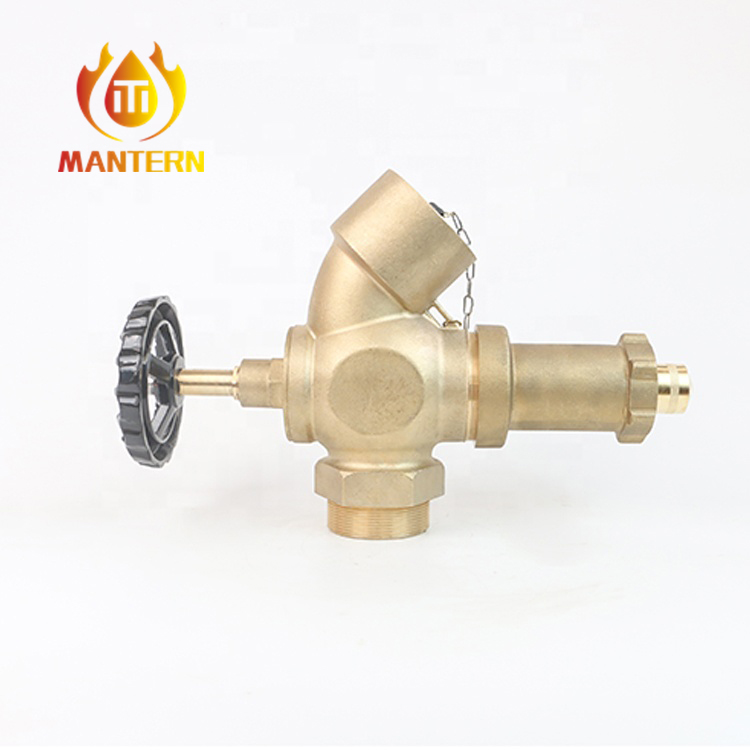
Engineers often confuse angle valves with standard fire valves. An angle valve merely describes a specific body shape. It turns the fluid flow exactly 90 degrees. A Landing Valve serves a highly specific fire protection function. Firefighters connect hoses directly to these units on stairwell landings. Many stairwell units utilize an angle body, but functional intent separates them.
Architectural placement dictates your geometric selection. Right-angle designs suit vertical wet risers perfectly. The horizontal outlet faces the operator while the inlet attaches vertically. Straight-through designs work better for horizontal pipe networks. Oblique designs tilt the outlet at a 45-degree angle. This slant prevents hose kinking in tight stairwells.
An indoor landing valve excels in low-to-mid-rise buildings. These environments offer stable, predictable supply pressure. Standard valves possess no internal pressure-regulating mechanisms. What enters the inlet exits the outlet minus minor friction loss. You specify standard valves only when static pressure remains below safe operational thresholds. They provide reliable, high-volume flow for unzoned systems.
Pressure Reducing Valves become a strict necessity in high-rise applications. Codes strictly prohibit hose connections exceeding safe operating limits. NFPA 14 limits standpipe hose connections to 175 psi static pressure. If your zone exceeds this metric, you must install a PRV.
Factory-set PRVs lock the outlet pressure during the manufacturing process. Manufacturers calibrate the internal spring using your submitted hydraulic data. They prevent unauthorized tampering after installation. Field-adjustable PRVs allow on-site tuning during the commissioning phase. Technicians adjust the internal bonnet to match actual site conditions. This flexibility proves invaluable when municipal water supplies fluctuate over time.
Improper sizing introduces severe mechanical risks. If you oversize a PRV for the baseline flow, the unit may "hunt." Hunting describes erratic internal component movement. The internal piston rapidly bounces between open and closed states. This creates violent pressure spikes. These spikes cause water hammer, which damages surrounding pipe joints.
Metallurgy dictates long-term equipment survival. Fire systems sit idle for decades but must function instantly. Gunmetal remains the premier industry standard. Gunmetal is a specialized bronze alloy containing copper, tin, and zinc. It resists dezincification exceptionally well. Brass offers a cheaper alternative but degrades much faster. High-zinc brass suffers from selective leaching in wet environments. Cast iron suits dry systems but rusts aggressively in unconditioned spaces. You should specify gunmetal for coastal buildings or harsh industrial environments.
We can summarize material performance in the chart below.
Material Type | Corrosion Resistance | Cost Tier | Optimal Application |
|---|---|---|---|
Gunmetal (Bronze Alloy) | Excellent | High | Coastal, industrial, unconditioned spaces |
Forged Brass | Moderate | Medium | Conditioned indoor commercial buildings |
Cast Iron | Low | Low | Strictly dry risers, non-corrosive environments |
Inlet and outlet specifications require exact matching. Standard inlet connections utilize either flanged or threaded ends. Flanged connections handle higher pressure ratings securely. Threaded connections save installation time on smaller diameter pipes. You must match the inlet type to the riser pipe material directly. Mixing incompatible metals causes galvanic corrosion.
Coupling compatibility ensures rapid emergency deployment. First responders cannot waste time using thread adapters. You must match the outlet to the local fire brigade's exact standard. British standard regions require BS336 instantaneous couplings. European regions frequently utilize Storz connections. North American systems rely on National Standard Thread (NST). Verifying this detail prevents catastrophic deployment delays.
Handwheel ergonomics directly impact crisis response. Operators must overcome massive static torque to open the unit fully. Cast iron handwheels withstand heavy physical impacts. Aluminum variants reduce overall weight but may crack under extreme abuse. The handwheel diameter must provide sufficient mechanical leverage. Small handwheels require excessive physical force. Ensure the wheel features deep grips for wet or gloved hands.
Global and local standards dictate baseline equipment safety. You must map out critical compliance frameworks before procurement. North American projects adhere strictly to NFPA 14. British and Middle Eastern markets often follow BS 5041-1. European installations rely on EN 671 guidelines. Each framework mandates different minimum wall thicknesses, flow rates, and testing procedures. You cannot substitute one standard for another blindly.
Third-party verification acts as your primary risk mitigation tool. Manufacturers can claim any performance metric on a brochure. Independent testing bodies validate these claims through destructive testing. Specifiers must demand visible casting marks on the equipment body. UL Listed and FM Approved marks dominate global specifications. The LPCB mark and BSI Kitemark hold immense authority in Commonwealth regions. These marks confirm the unit survived rigorous flow, pressure, and metallurgical audits.
Documenting compliance streamlines the final building handover. Building inspectors and insurance underwriters scrutinize system paperwork closely. Missing documents stall occupancy permits indefinitely. You must advise procurement teams to secure complete document packages.
Request the following compliance documentation from manufacturers:
Hydrostatic pressure test certificates for the specific production batch.
Independent laboratory flow curves proving actual GPM/LPM performance.
Material mill test reports verifying the exact alloy composition.
Detailed operation and maintenance manuals for facility management.
Architectural oversights routinely compromise system functionality. Installation clearances represent the most common field error. Contractors frequently install units too close to surrounding walls. Recessed wall cabinets often restrict hose attachment angles. Firefighters need substantial physical clearance to couple stiff, heavy hoses. They also need knuckle clearance to spin the handwheel rapidly. We recommend maintaining at least three inches of radial clearance around the entire handwheel. Poor positioning renders the best equipment entirely useless.
Seal and gasket degradation poses a continuous maintenance threat. Rubber components wear down inevitably. EPDM rubber seals dry out, crack, or compress over the years. Constant water pressure accelerates this physical degradation. We highly recommend selecting designs featuring easily replaceable internal seats. Facility managers can swap a degraded rubber seat in minutes. This modularity prevents costly full-unit replacements. It saves massive amounts of maintenance labor.
Testing and commissioning verify system integrity before human occupancy. Mandatory hydrostatic pressure testing occurs immediately post-installation. Technicians cap the outlets and pressurize the entire pipe network. Systems typically hold 200 psi for two hours. Inspectors walk the floors searching for weeping joints or faulty casting pores. You must execute complete flow testing for pressure-reducing models. Flow tests utilize Pitot gauges to confirm the unit delivers the exact residual pressure specified. Skipping these tests invites catastrophic failure during the first real emergency.
Choosing the correct equipment relies on a strict decision funnel. You must start entirely with hydraulic pressure data. Determine whether your specific building height requires mechanical pressure regulation. Specify your metallurgy based on atmospheric conditions and expected lifespan. You then verify that every inlet and outlet matches local brigade standards. Finally, you mandate independent testing certifications to eliminate functional risks.
Engineers and procurement officers must execute a structured shortlisting action plan. Cross-reference your building's engineering hydraulic model against manufacturer performance curves. Never rely on generalized product descriptions. Match the required residual pressure graph to your specific floor zones.
We urge you to request comprehensive technical data sheets (TDS) immediately. Obtain batch-specific flow-test certificates from shortlisted manufacturers. Compare these documents against your local fire code requirements. Rigorous upfront evaluation ensures your facility passes inspection and protects occupants flawlessly.
A: An angle valve simply describes a fitting that directs water flow at exactly 90 degrees. It is a geometric classification. A landing valve refers to a specific application on stairwell landings meant for fire department use. Many landing valves utilize an angle-body design, but they include specific hose couplings and handwheels for emergency operations.
A: International fire codes mandate them based on building height and floor area. Structures exceeding 30 feet in height generally require internal wet or dry risers. They ensure firefighters can connect hoses directly on the affected floor without running hoses up multiple stairwells.
A: Standard codes require annual visual inspections and partial flow testing. You must perform full flow tests under pressure every five years. Maintenance teams must emphasize checking for internal seat leakage, as degraded rubber seals cause dangerous pressure creep in the closed position.
A: No. Mixing standard valves in zones requiring strict pressure mitigation creates severe compliance and safety risks. Standard units lack internal mechanisms to prevent excessive pressure. Installing them in high-pressure zones violates fire codes and threatens to rupture fire hoses during deployment.
Mantern Industrial Co., Ltd. is engaged in international business since 2012. Our aim is to provide good products with competitive price for our clients.
